The short answer
In summer, a ceiling fan should turn anticlockwise when you look up at it, so it pushes air straight down and you feel a breeze. In winter, switch it to clockwise on a low speed, so it draws air up and pushes the warm air at the ceiling back down the walls. The quick test is to stand under the fan: if you feel a clear breeze, it's in summer mode.
Which way should a ceiling fan turn in summer?
Anticlockwise, seen from below. In this direction the angled blades push air straight down into the room. That column of moving air is what you feel as a breeze, and it's what makes you feel cooler.
Use whatever speed is comfortable. A higher speed gives a stronger breeze for hot afternoons, and a low speed is usually enough overnight. If you're sitting off to one side of the fan and can't feel much, go up a speed rather than changing direction.
| Season | Direction seen from below | Speed | What the air does | What you feel |
|---|---|---|---|---|
| Summer | Anticlockwise | Any speed you like | Pushed straight down under the fan | A direct breeze |
| Winter | Clockwise | Low | Drawn up, then pushed across the ceiling and down the walls | Little or no breeze, with a more even room temperature |
Which way should a ceiling fan turn in winter?
Clockwise, seen from below, on a low speed. In reverse the fan pulls air up through the middle of the room. That pushes the warm air sitting under the ceiling outwards and down the walls, where it mixes back into the room.
Low speed matters. The aim is to stir the air gently without creating a breeze, because moving air on your skin feels cool in any season. If you can feel a draught while the fan is in winter mode, turn it down a speed.
How do I check which way my fan is turning?
Watching the blades can be confusing, and blade shapes vary between models, so trust what you feel over what you see.
- Turn the fan on to a medium or high speed.
- Stand directly underneath it.
- If you feel a clear breeze on your head and shoulders, the fan is in summer mode.
- If you feel very little under the fan, but there is gentle air movement near the walls, it's in winter mode.
- If you want to confirm by eye, look up: on most fans, summer mode is anticlockwise and winter mode is clockwise.
Where is the reverse switch on a ceiling fan?
It depends on the motor type. On most AC fans, the reverse control is a small slide switch on the motor housing, usually on the side of the body just above or below the blades. Turn the fan off at the wall and wait until the blades have stopped completely before you move the switch, and use a stable step ladder to reach it. On some AC models the reverse is on the wall control or remote instead.
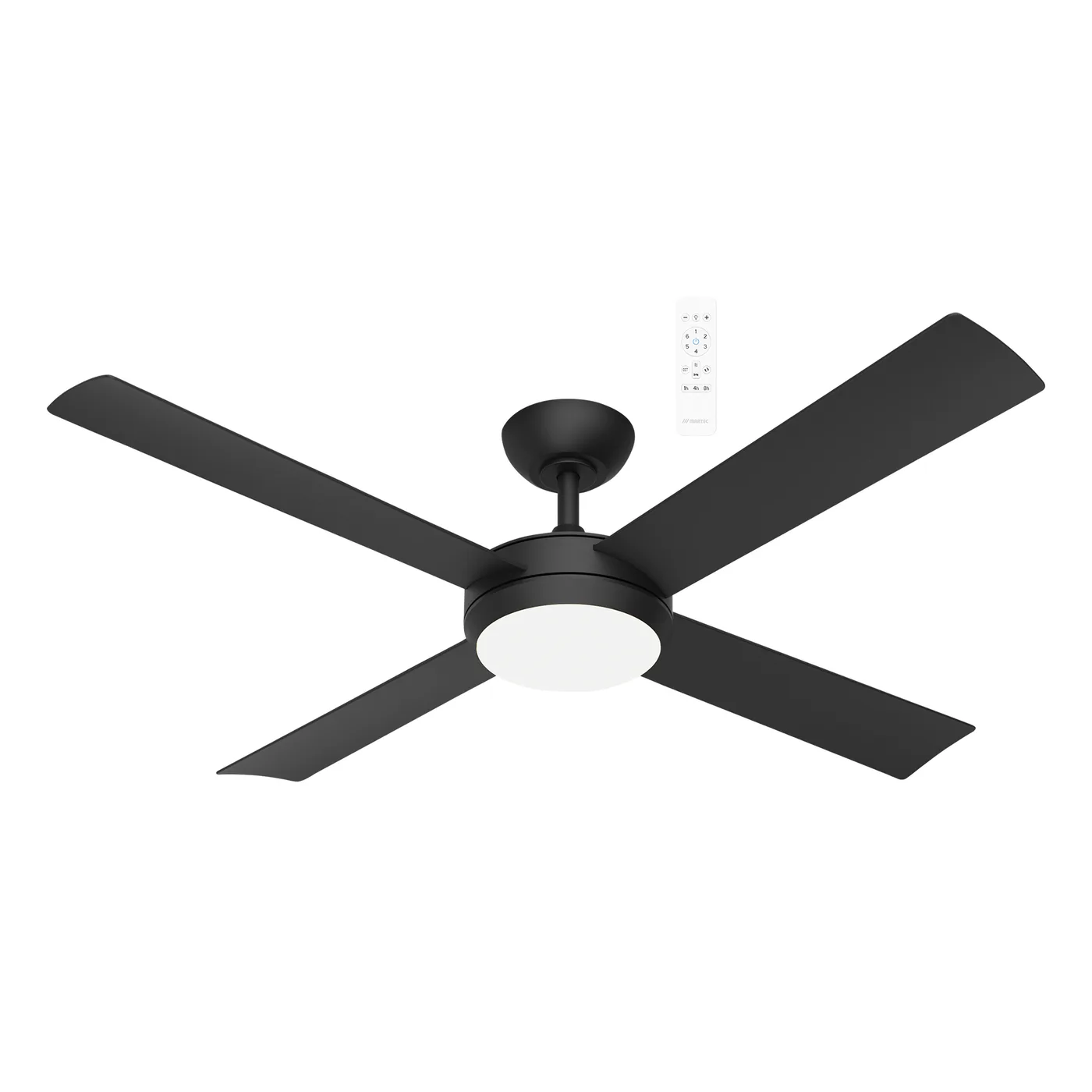
On most DC fans, reverse is a button on the remote, often marked with a pair of arrows or the letters F/R. Press it and the fan slows, stops and starts again in the other direction by itself. Smart fans can usually be reversed from the app as well.
If you can't find a reverse control, check the instruction booklet or the model's specification sheet. Not every ceiling fan can be reversed.
Does reverse mode make the house warmer?
A fan doesn't make heat. What reverse mode does is share around the heat you're already paying for. Warm air rises, so in a heated room the air near the ceiling is warmer than the air around your feet. Running the fan in reverse on low mixes the two, which can make the room feel more evenly warm at sitting height.
The effect is strongest in rooms with high or raked ceilings, and in living areas with a wood fire, gas heater or reverse-cycle air conditioner. In a room with a standard 2.4m ceiling the difference is smaller. It makes no difference at all in a room that isn't being heated.
Should I leave the fan on in winter?
Only while the heater is on and someone is in the room. Reverse mode on low is worth running through a winter evening in a heated living area. If you notice a draught, or the room is unheated, turn the fan off.
The same rule applies in summer. A fan cools people, not rooms: it makes you feel cooler by moving air across your skin, but it doesn't lower the temperature of the room. A fan spinning in an empty room is using power for no benefit, so switch it off as you leave.
Try both modes in our Albury showroom
If you're choosing a new fan, it's worth seeing how reverse works before you buy. At Lighting Bonanza, on the corner of Dean and David Streets, Albury, we have ceiling fans from Martec, Mercator, Eglo and Calibo running on display. Ask us to switch one between summer and winter mode so you can feel the difference, and to show you where the reverse control is on the models you're considering.